
Vol. 1 No. 1 (2025)
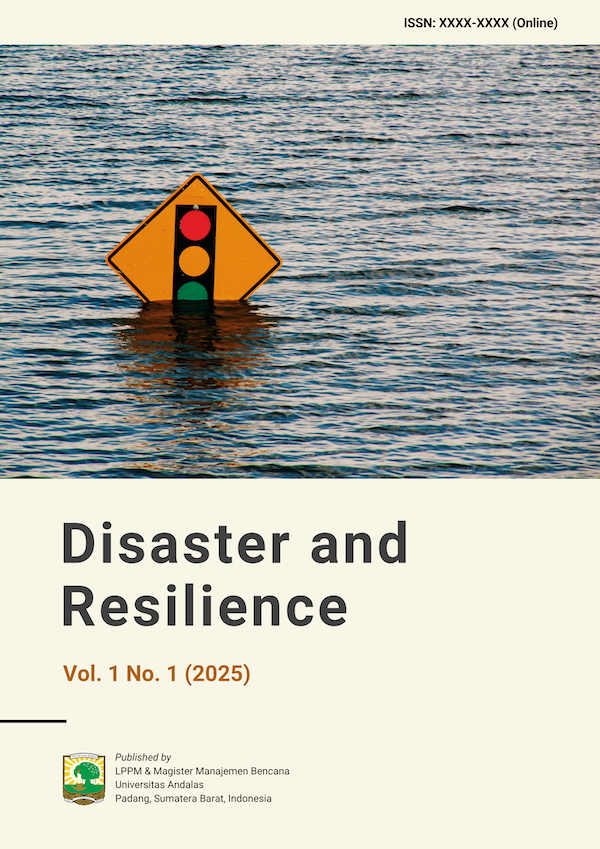
In this inaugural issue, Disaster and Resilience presents five pioneering articles that explore the intersections of indigenous knowledge, collective memory, grassroots governance, and community-based disaster risk reduction in Indonesia and beyond. Together, these contributions highlight how local cultures and institutions shape resilience strategies in disaster-prone environments, offering fresh perspectives for scholars, practitioners, and policymakers.
We open with M. Fedro Syafiola and Rinaldi Eka Putra’s study on Post-Earthquake Resilience of Minangkabau Communities. This ethnographic research reveals how the matrilineal kinship system, nagari governance, and religious practices form adaptive networks that accelerate recovery in West Sumatra. Their analysis emphasizes the value of hybrid governance models that integrate traditional institutions with modern disaster management for culturally grounded resilience.
Next, Muhammad Syaiful Anwar et al. examine Strengthening Community Capacity through Grassroots Disaster Governance by focusing on KBLK Kayu Kubu in Bukittinggi. The study details six community-based strategies—including disaster education, technical training, tourism partnerships, and media engagement—that demonstrate how local actors harness social capital and moral obligation to build sustainable disaster resilience at the neighborhood level.
Abdul Aziz Nasta contributes a comparative synthesis in Collective Memory in Disaster Management, drawing from international cases to explore how storytelling, monuments, digital archives, and commemorative practices fortify community preparedness. The article warns, however, that memory’s resilience depends on its renewal and integration into educational and policy frameworks, lest it become a static symbol disconnected from adaptive action.
Turning to Indonesian contexts, Muhammad Zulfian Saputra investigates Local Wisdom and Disaster-Related Collective Memory across diverse communities. His literature review highlights how practices like Ciptagelar’s earthquake-resistant architecture, customary environmental rules, and forest zoning serve as embodied risk-reduction systems. The study also cautions that modernization and top-down policies risk eroding these invaluable cultural assets.
Finally, Yozi Yuliardi offers a cross-country thematic analysis in Collective Memory as a Disaster Preparedness Instrument. The article demonstrates how memorialization practices—from Aceh’s tsunami museums to cultural festivals and social media archives—function as living repositories of disaster experience. Yuliardi calls for intergenerational and participatory revitalization to ensure that collective memory strengthens, rather than fades from, future disaster mitigation efforts.
Collectively, the articles in this issue illuminate the multi-layered, dynamic nature of resilience—where culture, governance, memory, and practice converge. We thank our authors, reviewers, and editorial team for their dedication to advancing disaster studies scholarship, and we hope this issue sparks new dialogues on how communities can navigate risk with wisdom, solidarity, and innovation.
Editor-in-Chief
Disaster and Resilience